The short answer
The strongest HubSpot alternatives for a small company are Pipedrive for a simple sales pipeline (from €14 per user per month), Zoho CRM for the lowest price with automations, folk or Attio for a small relationship-driven team, and Salesforce for an organization growing fast. To bring CRM, email, team chat and meetings into one tool, look at Atome.
HubSpot is often a company’s first CRM: a free plan to start, a polished interface, plenty of documentation. The questions come as the team grows. The free plan stops at two users, Professional costs $100 per seat per month with a mandatory $1,500 onboarding fee, and the features that matter are spread across several “hubs”.
We compared seven alternatives on what actually decides for a company of 5 to 50 people: the real price for a team, what you must pay to get automations, what the tool covers beyond sales, and what it does not do.
Disclosure: we make Atome, which is in this comparison. The other tools’ prices were taken from each vendor’s pricing page on November 1, 2026; sources are at the end.
Why small companies leave HubSpot
- The price climbs in steps. Serious automation needs Professional, billed per seat, with an onboarding fee. For ten people, the bill changes scale.
- It stays centered on marketing and sales. Internal conversations, notes, post-sale projects and meetings live in other tools.
- Data. Some companies want a European vendor and AI hosted in the EU.
HubSpot remains an excellent choice for a marketing team that uses its whole suite. If that is you, an alternative will mostly cost you features.
The comparison in one table
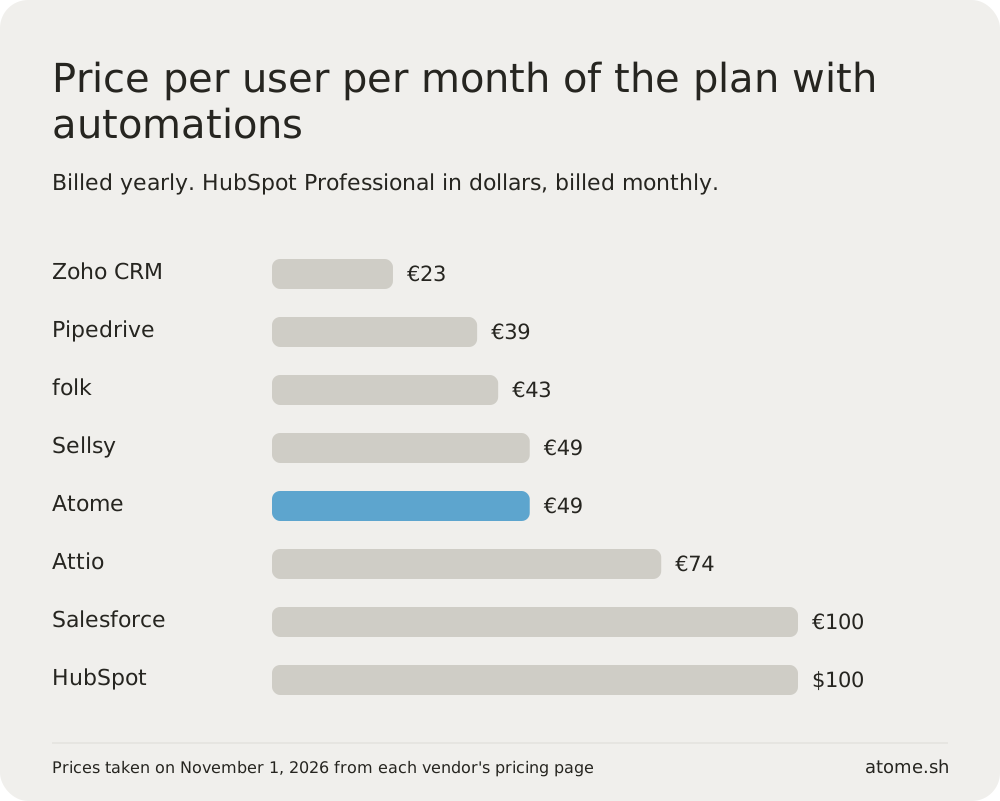
Price per user per month, billed yearly unless stated, taken on November 1, 2026.
| Tool | Entry plan | Plan with automations | Free plan | Setup fee |
|---|---|---|---|---|
| HubSpot Sales Hub | Starter (low price, 15 pipelines, 50 workflows) | Professional: $100 monthly | Yes, 2 users | $1,500 (Professional), $3,500 (Enterprise) |
| Pipedrive | Lite: €14 | Growth: €39 | No | None stated |
| Zoho CRM | Standard: €14 | Professional: €23 | Yes, 3 users | None stated |
| folk | Standard: €22 | Premium: €43 | No, 2-week trial | None stated |
| Attio | Plus: €31 | Pro: €74 | Yes, 3 seats | None, migration quoted |
| Salesforce | Starter Suite: €25 | Pro Suite: €100 | Yes (Free Suite) | Depends on partner |
| Sellsy | Sales Standard: €29 | Sales Evolution: €49 | No | None mandatory |
| Atome | €49 | Included | No | Migration and training by the team |
Pipedrive: the simplest sales pipeline
For: a sales team of 3 to 30 whose day revolves around moving deals forward.
Price: Lite €14, Growth €39, Premium €59, Ultimate €79 per user per month billed yearly, excluding VAT. Yearly billing saves up to 42% according to the page.
Strengths
- A very readable visual pipeline.
- Email sync, automations and sequences come with Growth.
- Premium adds lead scoring, quotes with e-signature and fine permissions.
Limits
- Lite has neither email sync nor automations: the useful plan starts at €39.
- It stays a sales tool: post-sale follow-up, team notes and internal chat live elsewhere.
Pick it over HubSpot if you want a pure sales CRM, without the marketing suite, at a predictable per-seat price.
Zoho CRM: the lowest price with automations
For: a company on a tight budget, or one already using other Zoho apps.
Price: Standard €14, Professional €23, Enterprise €40, Ultimate €52 per user per month billed yearly; free for up to 3 users. Local taxes are added.
Strengths
- The lowest price in this comparison for comparable features.
- Professional adds AI agents, quote configuration and unlimited reports.
- Connects to the rest of the Zoho suite.
Limits
- A denser interface that takes configuration to feel good daily.
- The pricing page does not quantify the limits between plans.
Pick it over HubSpot if price per seat comes first and you have time to configure.
folk: a CRM for small relationship-driven teams
For: a few people managing relationships more than volume: partnerships, hiring, fundraising, a small number of deals.
Price: Standard €22, Premium €43, Enterprise from €67 per user per month billed yearly (€27, €54 and €83 monthly). No free plan; a two-week trial.
Strengths
- Very quick to pick up, built around contacts.
- Premium adds sequences and deals.
Limits
- Standard has no sequences, deals or custom objects.
- Message caps per member (2,000 a month on Standard, 5,000 on Premium).
Pick it over HubSpot if your team is small and your work fits in a well-kept contact list.
Attio: a CRM you shape yourself
For: a startup that wants to model its own objects and automate from its data.
Price: free for up to 3 seats, Plus €31 (10 seats maximum), Pro €74 per user per month billed yearly (€39 and €93 monthly).
Strengths
- A flexible data model: objects, attributes and views your way.
- Pro removes the seat cap and goes up to 12 objects and a million records.
Limits
- Workflows and AI use credits, capped per plan (1,500 on Plus, 10,000 on Pro).
- Plus stops at 10 seats: a growing company soon moves to €74.
Pick it over HubSpot if someone on the team will design the data model and keep it alive.
Salesforce: room to grow without a ceiling
For: an organization growing fast, with a person or partner dedicated to the CRM.
Price: Starter Suite €25, Pro Suite €100, then €195, €395 and €550 per user per month for Enterprise, Advanced and Max, billed yearly.
Strengths
- Customizable almost without limit, with a very large ecosystem of apps and partners.
- Starter Suite lets you start small.
Limits
- The jump from Starter (€25) to Pro Suite (€100) is steep.
- Roll-out often goes through a partner, which adds cost and time.
Pick it over HubSpot if you expect to double in size and run complex sales processes.
Sellsy: selling and invoicing in one place
For: a French or European company that wants quotes, invoices and sales follow-up in one tool.
Price: the Sales plan costs €29 (Standard), €49 (Evolution) or €79 (Elite) per user per month billed yearly, excluding VAT, with a 12-month commitment.
Strengths
- Quotes, invoices and CRM together.
- No mandatory setup fee.
Limits
- Standard is tight: 3 custom fields, 3 dashboards, 2 profiles.
- The interface and support are built first for the French market.
Pick it over HubSpot if invoicing matters as much as prospecting.
Atome: one tool for the whole company
For: a company of 5 to 50 that wants clients, email, team chat, calendar, meetings and documents in one place.
Price: €49 per user per month billed yearly, €59 monthly, excluding tax, every feature included, with a monthly AI allowance per person. No free plan.
Strengths
- CRM, shared inbox, a chat on every record, calendar and booking links, meeting recording and documents in the same tool.
- An AI that works on all of it and sends an email or invite only after you approve it in the chat.
- Data hosted in the EU; AI runs on Mistral AI in France and Cortecs in Austria.
- The team moves your data from HubSpot and trains each role.
Limits
- No accounting or payroll: those stay alongside.
- No free plan.
- Fewer ready-made integrations than HubSpot or Salesforce.
Pick it over HubSpot if your problem is not only the CRM but the number of tools a client’s story is scattered across.
What each option costs for ten people
Each tool’s first plan with automations, for one year, excluding setup fees unless stated.
| Tool | Plan | Yearly cost for 10 people |
|---|---|---|
| Zoho CRM | Professional, €23 | €2,760 |
| Pipedrive | Growth, €39 | €4,680 |
| folk | Premium, €43 | €5,160 |
| Sellsy | Sales Evolution, €49 | €5,880 |
| Atome | €49 | €5,880 |
| Attio | Pro, €74 | €8,880 |
| Salesforce | Pro Suite, €100 | €12,000 |
| HubSpot | Professional, $100 monthly | $12,000 + $1,500 setup |
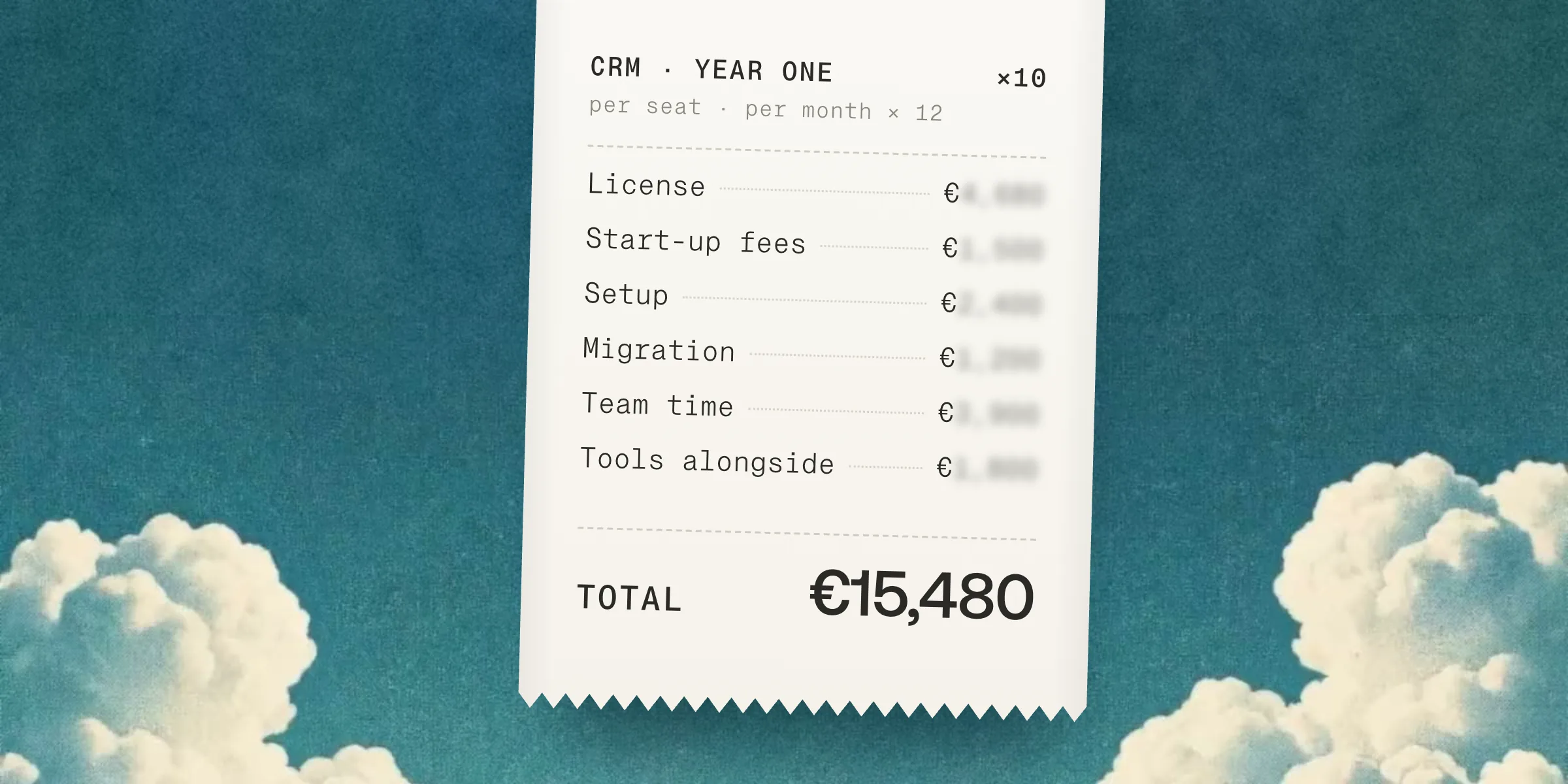
This counts the CRM only. For a fair comparison, add the subscriptions each tool does not replace: team chat, notes, booking, meeting notetaker. That is where a specialised CRM and an all-in-one tool really differ.
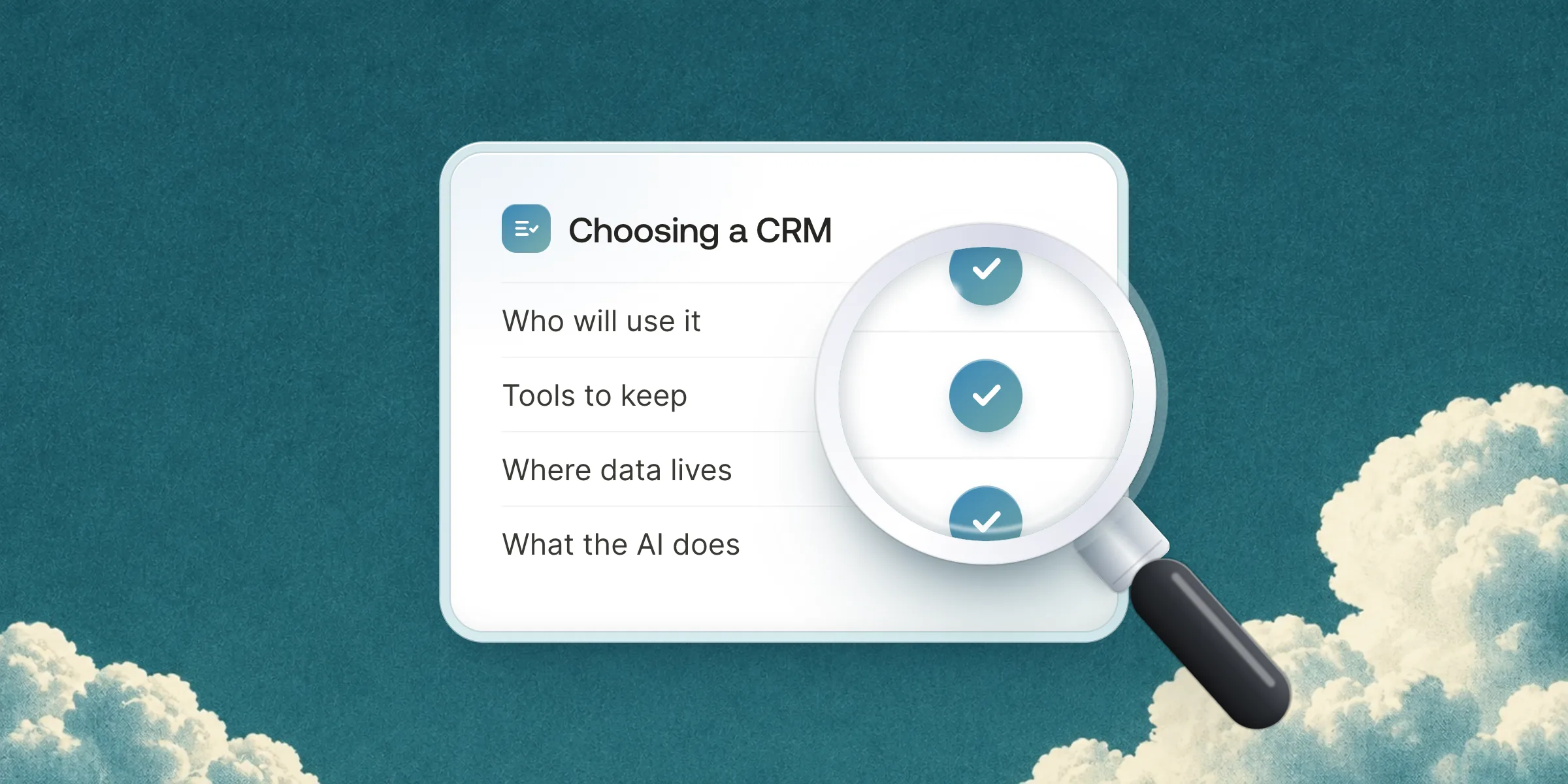
How to choose
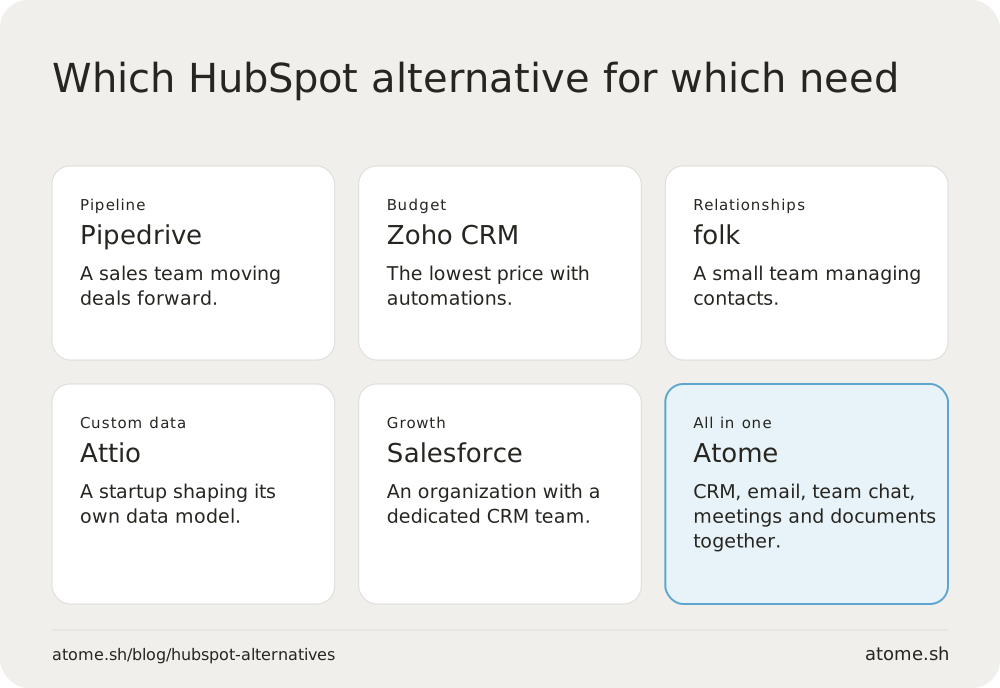
- List who will use it daily. Sales only: Pipedrive, folk or Zoho are often enough. The whole company: look at Atome, or Salesforce if you have a dedicated team.
- Decide how many tools you want to keep. If the answer is “as few as possible”, compare total cost, not just the CRM.
- Check where your data lives. Read each vendor’s sub-processors page, AI included.
- Test on a real day. Import a hundred real contacts and have two people work in it for a week.
For the full method, read How to choose a CRM for a small company in 2027.
Leaving HubSpot without losing your history
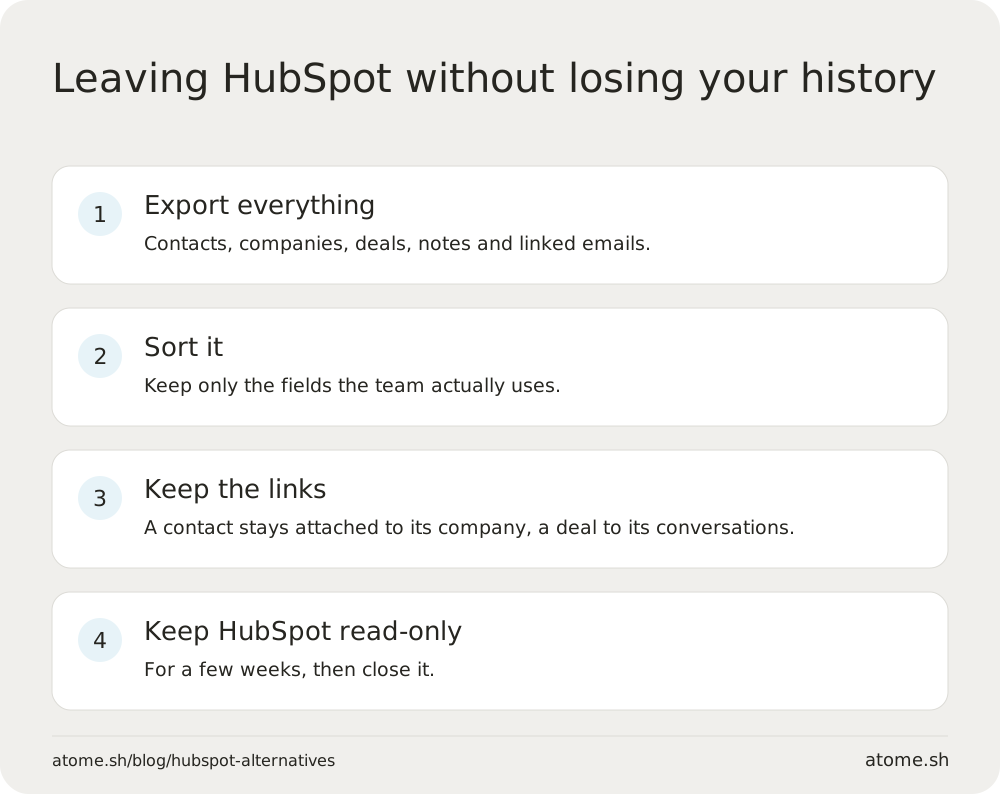
- Export everything: contacts, companies, deals, notes and linked emails.
- Sort it: keep only the fields the team actually uses.
- Keep the links: a contact stays attached to its company, a deal to its conversations.
- Keep HubSpot open read-only for a few weeks, then close it.
Sources
Prices taken on November 1, 2026 from each vendor’s pricing page: HubSpot, Pipedrive, Zoho CRM, folk, Attio, Salesforce, Sellsy. Except for Pipedrive and Sellsy, the pages do not say whether prices exclude VAT. Prices change: check the vendor’s page before you decide.