



A structure only admins change
Admins own the tables and fields, everyone else works in the apps built for them, and the numbers stay right.
Build your company's internal apps on one set of data, and give each person the access they need.
Why teams leave Notion
Admins own the tables and fields, everyone else works in the apps built for them, and the numbers stay right.
Conversion rates, pipelines and pivot tables, in the apps where the team works.
Access is set per record and per field, so each person sees only what concerns them.
More than a CRM
Email: Gmail and Outlook, shared inbox, campaigns
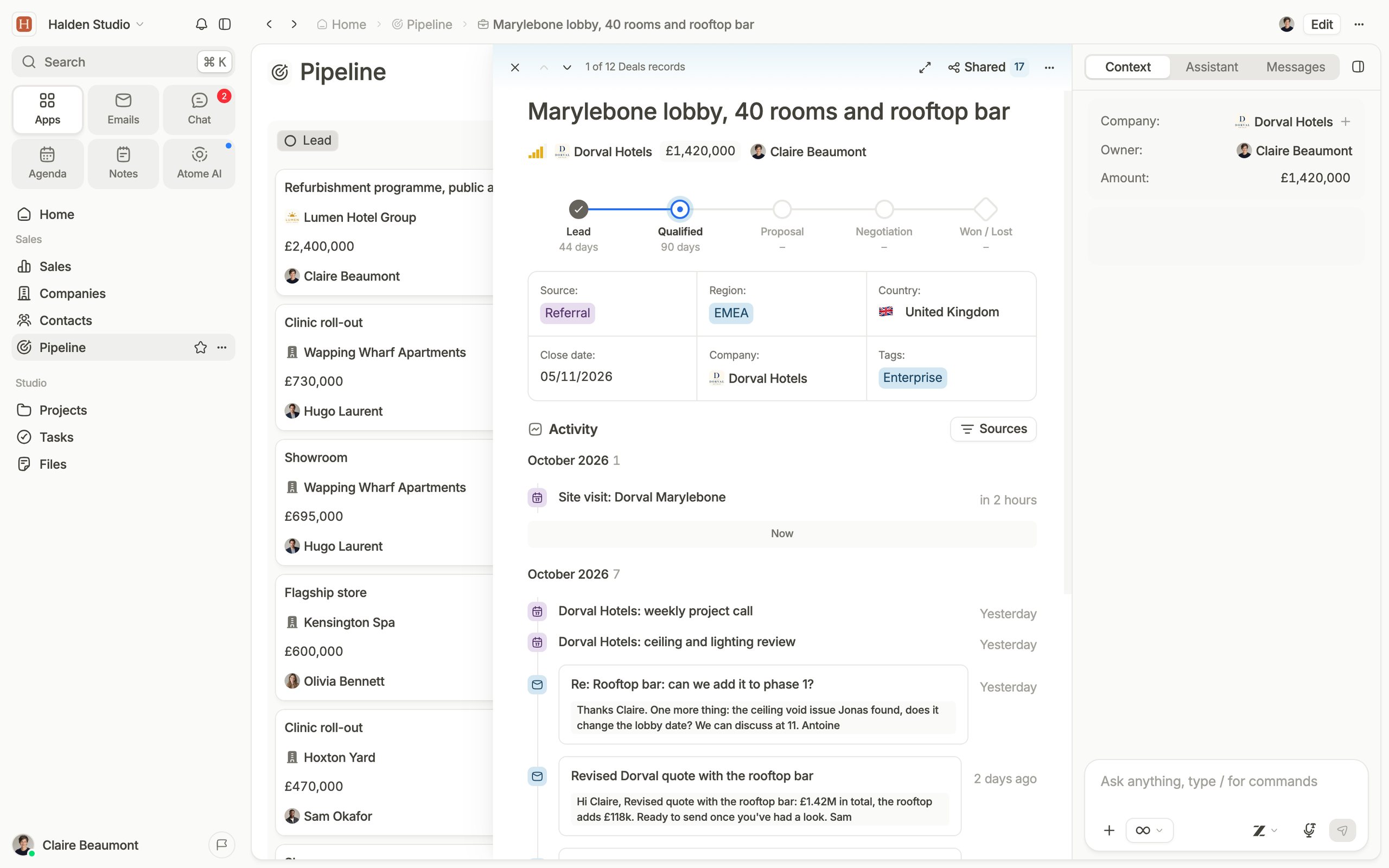
Every email is saved on the client and the deal it belongs to, for the whole team.
Calendar: Google and Microsoft sync, team calendars, scheduling
Clients pick a time from your scheduling link, and the meeting is saved on their record and their deal.
AI notetaker: transcript, summary, next actions
Atome records the call with a client, saves the summary on their record and lists the next steps.
Docs: notes, proposals, meeting briefs
Every note and proposal is saved on its client's record, for the whole team.
Enrichment: company and contact details filled in
Add a company's website, and Atome fills in its industry, size, location and LinkedIn.
AI brain: full context on all your data
Ask which clients have not replied in two weeks. The AI answers from your emails, meetings and files.
Each client and each deal has its own chat thread for the team.
A deal moves to the next stage, and Atome sends the email and creates the tasks.
A form on your website creates the contact and the deal, and gives the deal an owner.
Set the stages, fields and views of each pipeline: client deals, hiring or partners.
Comparison
What each one includes, as each company publishes it. Checked November 2026.

What it is
AI CRM and app builder
Docs, wikis and databases
Set up by
Who does the first configuration
The Atome team, with you
Your team
Where data is hosted
European Union
European hosting providers
United States
EU hosting on Enterprise only
Admin side and user side
Who can change the structure
Admins only
Any editor, unless the database is locked
Many apps on the same data
One table, one app per team
Each app shared with its team
Same access on every page
Tables and relations
Typed fields, relations, lookups, rollups
Databases, relations and rollups
Views
Table, board, calendar, timeline, gallery
Charts and dashboards
On your live data
10 chart types, KPIs, pivot tables
Bar, line, donut; dashboards on Business
Custom blocks
Code generated by the AI
Connected to your data
HTML blocks
Apps built by the AI
You describe it, the AI builds it
Pages, automations and agents
Pages and databases, not automations
Forms
Multi-step, conditional logic
Conditional logic on Business
Automations
Paid plans
Large volumes
Rows per table
No limit
250,000 max, slows down as it grows
Row-level permissions
e.g. the North region for the North team
On any criteria
By person only, on Business
Column-level permissions
e.g. margins visible to finance only
Admins included
Up to 20 columns, on Business
Conditional visibility
Each person sees a different page
Same page for everyone
Client portals
Each client sees only their data
One rule is enough
Guests page by page
Contacts and companies
Created and enriched automatically from emails
A template, filled in by hand
Emails on each record
Gmail and Outlook, two-way sync
Notion Mail closed in September 2026
Shared drive
Files and attachments, in folders
Linked to your records
Files kept page by page
Calendar
Google and Microsoft, two-way sync
Notion Calendar, a separate app
Meeting recording
Transcript and summary
Saved on the client record
Business plan and up
Team chat
Page comments only
AI
Knows your records, emails, meetings and files
Full on Business, a trial below
Email campaigns
Scheduling
Clients book a slot from your link
In Notion Calendar
PDFs generated from records
Quotes, proposals, reports
Page export to PDF
E-signature
Starting price
Per user, per month, billed yearly
€49
Excluding VAT
€9.50
Plus plan; €19.50 on Business with AI
Sources: notion.com, Atome
Which one fits
Notion suits teams that share docs and a wiki. Atome is built for internal and business apps: admins set up the data once, build as many apps on it as each team needs, and rules decide who sees what.
Fits better if
Fits better if
How the switch works
Our team plans the move with you, imports your pages and databases, sets who sees what and trains your teams. Notion keeps running until your team works in Atome.
We go through your teamspaces with you and choose what moves, which app each team gets and who sees what.
Pages, databases, relations and files are imported and checked with you.
Short sessions, by team, on the work they do every day.
When your team works in Atome, you export a last copy of the workspace and cancel the plan.
What moves over
Your pages and databases move into Atome, with their files and relations. Our team rebuilds your teamspaces as apps, your sharing as access rules, and your formulas, forms and automations, with you.
Pages and docs
Notes
Moves as it is
Meeting notes
Meeting notes
Moves as it is
Databases and their pages
Your tables
Moves as it is
Clients, contacts and companies
Contacts and Companies
Moves as it is
Projects and tasks
Projects and Tasks
Moves as it is
Relations and rollups
Relations, lookups and rollups
Moves as it is
Files and images
Files attached to records
Moves as it is
Database views
Views
Moves as it is
Teamspaces and the sidebar
An app for each team
Rebuilt with our team
Sharing and guests
Access rules and guests
Rebuilt with our team
Formulas
Calculated fields
Rebuilt with our team
Forms, buttons and automations
Forms and automations
Rebuilt with our team
Public sites
Stays in Notion
Integrations and synced databases
Stays in Notion
FAQs
Owners and admins. They build the tables, fields, apps, forms and automations. Members work in the apps shared with them, and the AI and the agents follow the same access rules.
Yes. You invite them as guests. A rule gives each guest the records linked to their company, to view or to edit, and you share the apps they work in. They see nothing else.
Pages come over as notes, with their headings, lists, tables and code blocks. Each note can then be linked to the client, project or deal it concerns.
Into an app: its pages form a tree in the sidebar, and a page can hold notes, views of your tables, titles and images. You choose who sees each one.
Yes. Each database becomes a table with typed fields, and its relations are linked again during the import. Our team rewrites your formulas with you in Atome's calculated fields.
Yes. You can start with one database or one team, keep Notion for the rest, and switch it off when your team has moved.
Our implementation team, with you: planning the switch, migrating your data and training your teams.
In the European Union. Servers and file storage are provided by UpCloud, and the database by Aiven in Germany. Atome AI runs on Mistral AI in France, and on European servers through Cortecs in Austria. The sub-processors page lists every provider.
€49 per member per month, excluding tax, billed yearly, or €59 billed monthly. Each member gets a monthly AI allowance.
For any other question, book a demo.
A call with our team, your setup on screen, and a plan for the move.